Showing posts with label Math. Show all posts

Monday, July 21, 2014

Mathy Monday-Number Talks

Testing, testing...is this thing on?  It's been a while since I've blogged, but like many of you, my brain is shifting back into school mode whether I like it or not! So I'm jumping right back in with a Mathy Monday post about Number Talks, one of my favorite parts of my entire day.  So let's get to it!  

What is a Number Talk?
Have you ever stumbled upon something, a product or simple routine, that yields amazing results?  This past year, for me, it was the number talk routine.  This short 15-20 minute snippet of our day transformed my students into mathematical communicators, capable of speaking about their conceptual understanding, constructing arguments about their problem solving, questioning and critiquing the reasoning of others, and eventually, using this foundation to write about their thinking.

A number talk is a daily routine in which students have a chance to deepen their mathematical thinking.  For teachers, number talks are a great way to quickly and informally assess understanding while helping students transition from ineffective to more effective and efficient problem solving techniques.  During number talks, a problem is posed, students solve the problem individually using their mental computation skills, then students discuss their problem solving while the teacher records their method. In the primary grades, number talks focus on developing number sense, building fluency with small numbers, subitizing, and making tens.  In the intermediate grades, number talks still focus on deepening number sense, but also develops place value understanding, builds fluency, strengthens properties of operations and helps connect mathematical ideas.  Number talks provide big bang for your buck!

Where do you even begin?!
 As with any new routine,  it's all about consistency and implementation.  First, decide what mathematical idea you want the students to consider.  Is it strategies for adding multi-digit numbers?  Building equal groups from a set?  Or determining a quantity of counters on a ten-frame.  The beauty of number talks is that they can be modified and adapted to address almost any mathematical concept. 

Next, set the purpose for your students and introduce the routine.
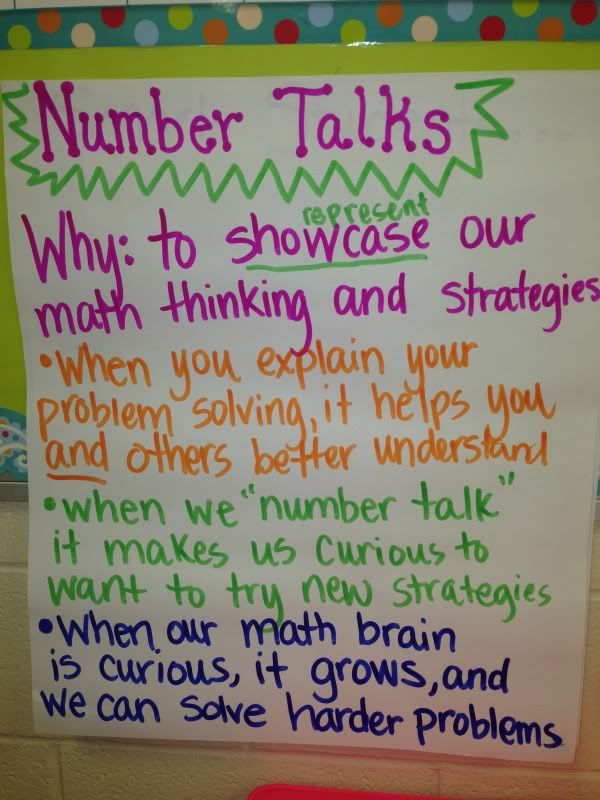
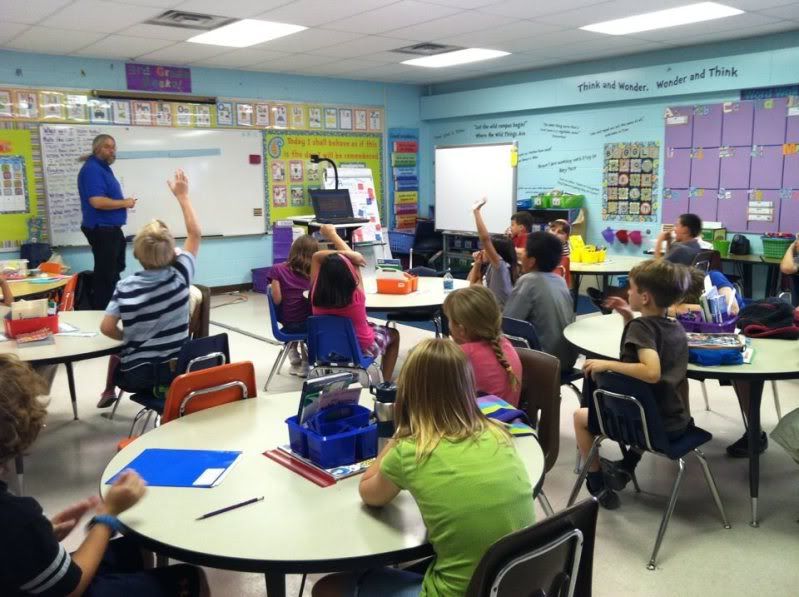
In my classroom, a problem is posed, students silently solve the problem mentally, then they give a "secret thumbs-up" (thumbs-up in front of their body) to let me know they have solved the problem.  When the majority of thumbs in the room are up, I begin to cold-call students to share their thinking aloud with the class.  As they share, it is your job to ask questions to help clarify and solidify their understanding.  Over time, students will begin to ask questions of each other as their curiosity grows.  Modeling good questioning and providing students with thinking stems is key in promoting student-to-student interaction.  Simple stems like "How did you know to..." or "Why did you choose to..." and "I'm curious about the way you..." can promote a spirit of inquiry, which strengthens understanding for the student explaining, as well as those listening.  

Now, this is important, in my classroom, we emphasize the thinking behind the problem solving, as opposed to the correct answer.  And because of that, mistakes will be made.  But guess what?  There is power in mistake making.  My favorite mathematician, Jo Boaler explains it: 
   
 
 Allowing students to work through the thinking behind their mistakes has proven to be extremely powerful in my classroom.  Of course, the environment in which students have a sense of safety to be able to take risks without fear of being labeled a failure is crucial in developing the growth mindset that Jo mentions above.  

So, what does it look like?
Number talks look different in every classroom, and as a teacher, you modify it to meet your students learning styles and needs.  Youtube has tons of sample number talk lessons that teachers have shared from around the country.  Here are a few of my favorites that illustrate how different it can look, yet also show how powerful the mathematical conversations can be.


My students loved the number talk routine this past year, and as their teacher, I loved the impact a small routine had on deepening student understanding, developing mathematical communication skills, and building confidence in our learning.  I will definitely continue to number talk with my 3rd graders this upcoming school year. If you still have some fight left in you, I encourage you to check out "Number Talks" by Sherry Parrish.

So what about you?  Do you number talk?  What has your experience been?

Happy Mathy Monday!

Sunday, March 9, 2014

The Test

It's that time of year...time for the big TEST!!  For my 3rd graders, this is their first experience with State standardized testing, which means as their teacher, I have a big responsibility.  Yes, I must prepare them academically, but more importantly, I have to make sure that their first testing experience is a positive one.  So, like many classrooms all over the country, we go into "test prep mode".

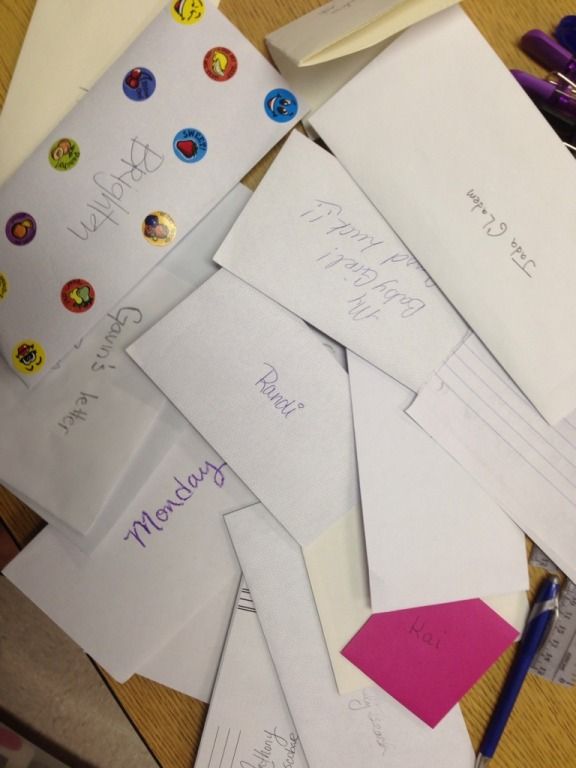
I begin at least a month out, usually around Spring Parent Conference time.  I make sure to talk to parents about the test and what they can expect.  I also ask them to write an encouraging note for their child so that when we begin testing, their child has that extra little bit of motivation to help them get through those long days.  In the past, my students have really LOVED these special notes.  Most of the time they have notes from their parent or guardian, but every now and then, a drawing from a little brother or sister makes it into the mix.  No matter who the note is from, the look of pride on my students' faces are priceless.

Another big component of "test prep" is minimizing fears and maximizing confidence.  We talk honestly about the test-how long the sessions will be, what our days will look like, and what types of things will be covered on the test.  They usually have TONS of questions, but taking time to talk these things out usually helps students feel less anxious.

In the weeks leading up to standardized testing, I do everything in my power to give my students as many opportunities for success as possible.  This looks different for every student, but these small moments help build confidence.  Every chance I get, I provide feedback for the things they are doing well, and then help to guide them one step further.

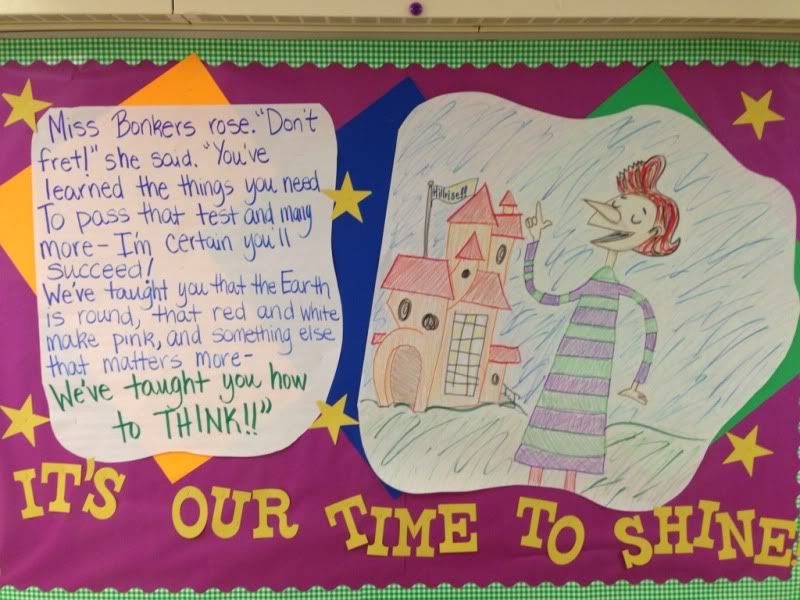
As testing gets closer (next week, for us) I always make a point to read "Hooray for Diffendoofer Day", by Dr. Seuss (and Jack Prelutsky & Lane Smith).  This is one of my all time favorite books that highlights individuality and creative thinking.  My students can connect to the students at Diffendoofer School, who are also taking a big test.  Of course, because they have been taught to think, they succeed.  Awww! 


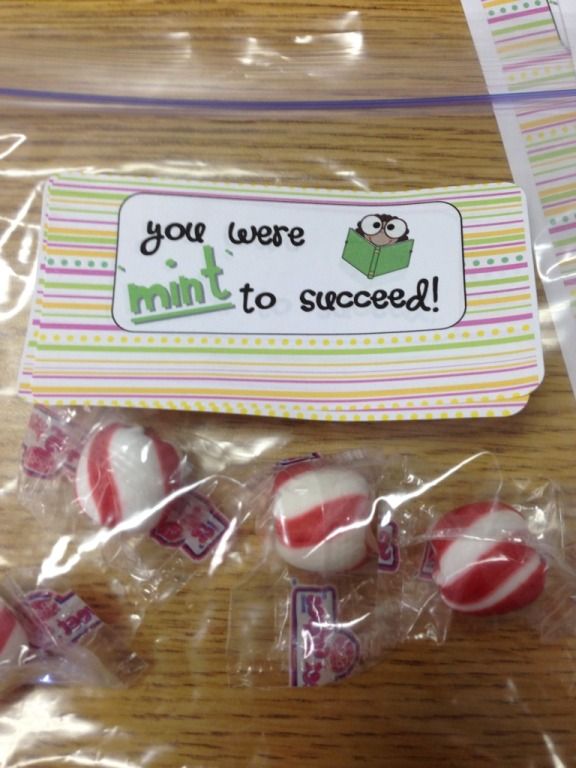
When it's time to cover the walls, I plaster them with motivational quotes and messages of support.  I want to leave no doubt in their minds that I truly believe in them and think the world of them, regardless of the outcome of the test.  And of course, being mature enough for testing makes you also mature enough for special treats and surprises along the way.

Do you have any "test prep" rituals that help get your students through testing?  I'd love to hear, so share away!  
 

Thursday, October 3, 2013

Multiplication, Mice, and Math practices

I can hardly believe October is here!  With cooler weather comes one of the concepts that students are most excited to learn about in 3rd grade...multiplication!  I've written before about how important the idea of multiplication is in 3rd grade, and how the progression of concepts eventually leads to the concept of the Distributive Property, but did you know that multiplicative concepts encompass an entire critical area in 3rd grade Common Core?!?!  Let's just think about that for a second and 'word-nerd' it-- According to dictionary.com:
critical-adj 
1. containing or making severe or negative judgments
2. containing careful or analytical evaluations: a critical dissertation
3. of or involving a critic or criticism
4. of or forming a crisis; crucial; decisive: a critical operation
5. urgently needed: critical medical supplies
6. informal  so seriously injured or ill as to be in danger of dying
7. physics  of, denoting, or concerned with a state in which the properties of a system undergo an abrupt change: a critical temperature
8. go critical  (of a nuclear power station or reactor) to reach a state in which a nuclear-fission chain reaction becomes self-sustaining
Basically, with the help of multiplication, our 3rd graders will reach a state of nuclear-fission!!  But in all seriousness, I think the fifth definition sums it up best, multiplicative concepts in 3rd grade are "urgently needed" so that our students have a foundation so strong enough to support and deepen their understanding of later concepts and grades.

So, obviously, multiplication is important, but how do we, as teachers, build that strong foundation?  For us, we start by thinking about the math ideas necessary to truly understand the concept of multiplication.  Together with my amazing third grade team, we mapped out what we believe to be a logical progression of ideas that would support the bigger idea of multiplication in 3rd grade.  Here is what we came up with: repeated addition, skip counting, equal groups, arrays, area models (area as additive, then multiplicative), and eventually, the concrete proof of the Distributive Property.  In reality, these ideas will be the primary focus of our math instruction, and will take us until about mid-November until we move on to other (related) concepts.

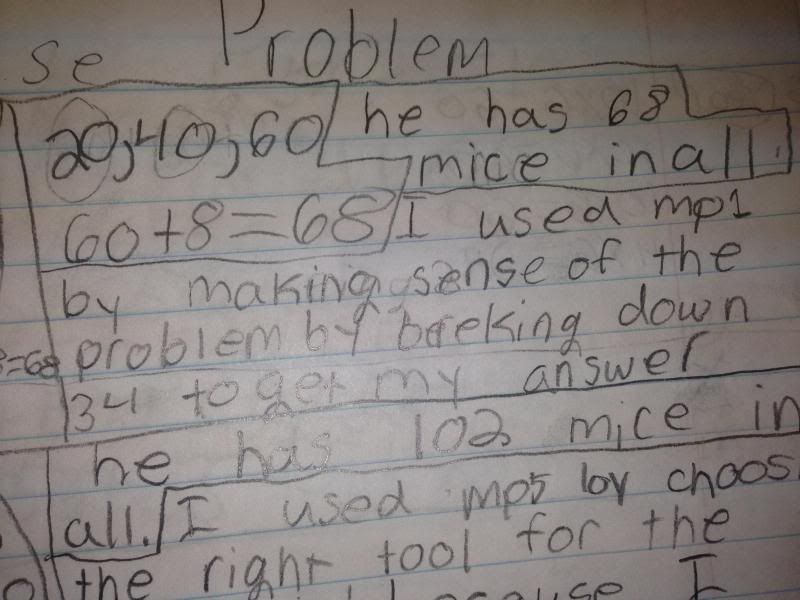
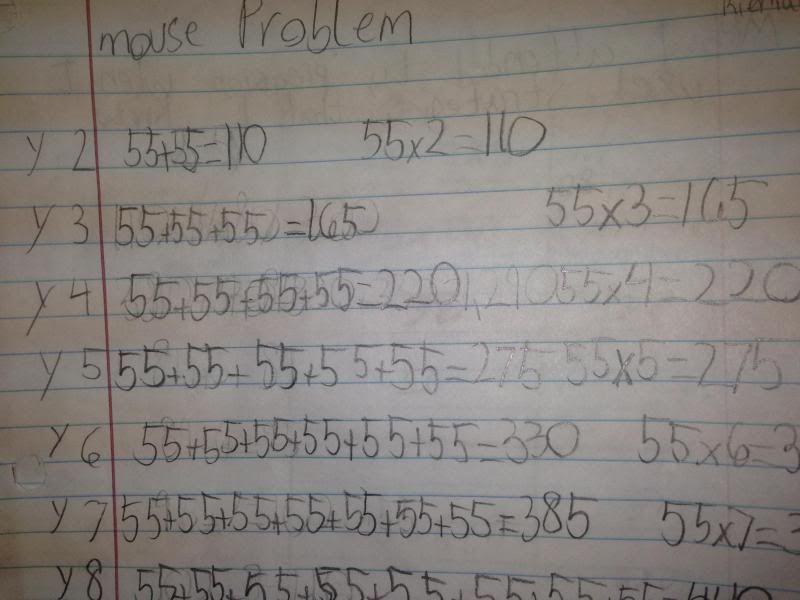
We are currently in our third week of building multiplicative concepts in 3rd grade, and I can definitely say that my students are using a very wide variety of strategies to solve our multiplication math tasks.  Today, we completed a "Mouse Problem" in which students were asked to select a number of mice to "buy" from the pet store.  Each year, their mouse population increases in size (2nd year, population doubles, 3rd year it triples, and so on), and students were asked to figure out how many mice they would have by the 5th year.

Skip Counting in parts
Multiplication with repeated addition

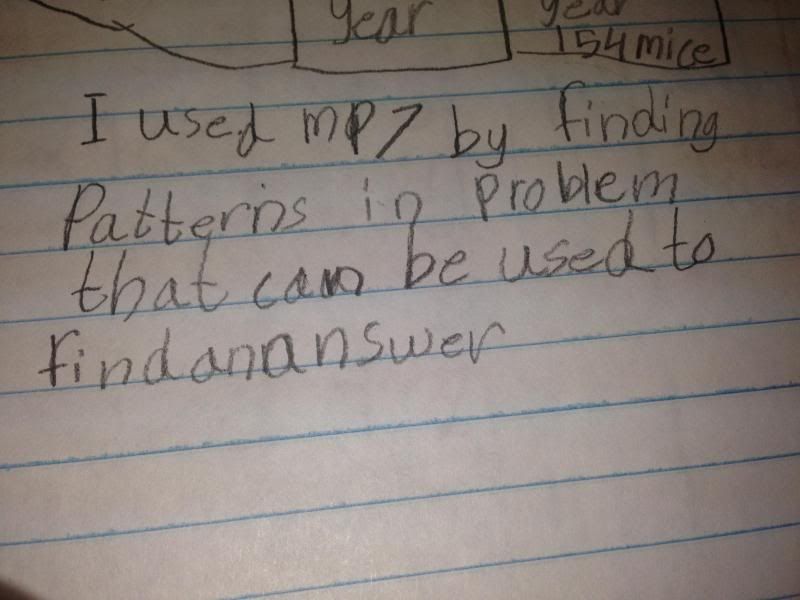
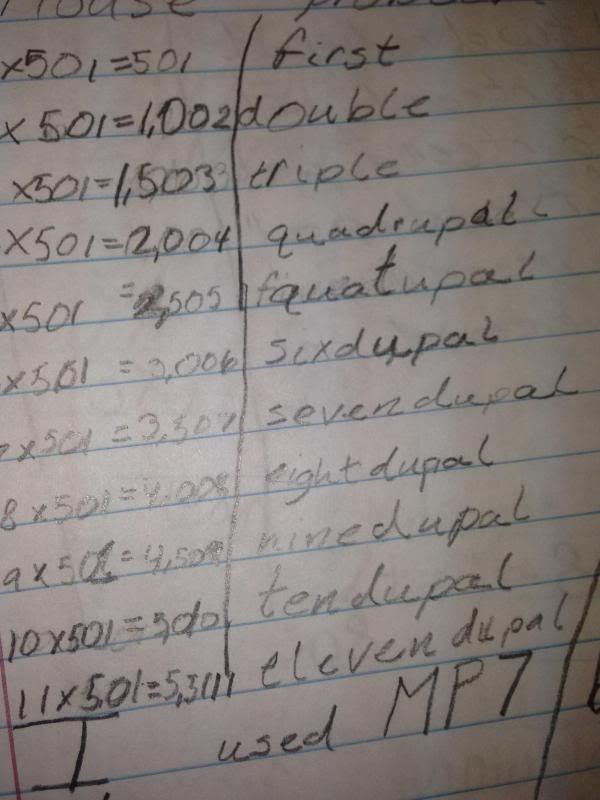
And some of our progress with Math Practice Standards...


This last pic is my fav because it is SO 3rd grade.  This student had a very interesting patterning strategy to find their products, and was extremely ambitious in the original number of mice they started with (501), but check out the "math" vocabulary!  I LOVE "sixdupal" and the others that follow it, and I can definitely appreciate an attempt at attending to precision in our mathematics vocabulary.

Now that October is here, what are you working on in your classroom?

Monday, September 9, 2013

Mathy Monday- MP Edition

Holy moly!  Has it really been over a month since I've blogged on here?  Apparently, it has, but in my defense...back-to-school is all consuming!  I consider it pure luck that I could even remember my password for this ol' thing.  But now that I'm here, let's make this a Mathy Monday and chat about making the Standards for Mathematical Practice accessible to kids. 

New Mexico is one of 45 states that have adopted the Common Core State Standards, and as a third grade teacher here in the Land of Enchantment, we are in our second year of adoption.  It's actually a really nice place to be- we've had a year to play around and try things out, and now, we have a chance to keep what worked and refine what didn't.  Our approach to introducing the Standards for Mathematical Practice is something that worked, and this is how we do it.

We begin each week by introducing the MP using the language directly from the Common Core.  Often times (much more often than not), this language can be extremely challenging for third graders, but this provides the perfect opportunity to implore reading strategies for encountering unknown words while getting kids to "think about their thinking" in mathematics. 

We start with an anchor chart with only the MP written (see picture below, blue ink).  We dissect the language of the MP using prior knowledge, word association, context clues, and even dictionaries.  As a class, we talk it out and break it down so that we come to a common understanding so that all students know what is expected of them. 

From there, it's time to do the math.  Math tasks are selected intentionally so that students have explicit opportunities to engage in the math practice standard.  For example, for MP 1- Making sense of problems and preserve in solving them, students were given a multi-step math riddle that could be solved in many different ways, but would require perseverance to determine the correct answer. 

As students work, I ask guiding questions that will help facilitate our summary at the end of the lesson.  I craft my questions based on what students understand about the math practice (ex: What strategies are you using to make sense of this problem?  Talk to me about how you are persevering through this tough work...").  By doing this, students have already began to think about how they use the math practice in their own work.       

  
After students have had a chance to do the math, we come back together to summarize and debrief the math practice standard.  I try and use the same guiding questions I used during the exploration so the language is consistent.  I record student responses in another color (green) on our anchor chart.  Your landing point should be along the same lines as the expanded MP standards in kid-friendly language.  Throughout the week, we constantly refer back to the MP standard, whether I am pointing out ways in which students are using it, students are identifying how other students are using it, or they are reflecting on their own use of the MP standard.  Later, we add sentence stems to promote the use of the direct language when speaking and writing about our math thinking.


While this took time, it was well worth it.  I was amazed to hear 3rd graders talking about "attending to precision" and "choosing appropriate tools strategically".  More importantly, these are the habits of mind we hope to instill in our students, so being able to refer back to them while I am teaching helps build self-efficacy skills that are invaluable.     

So, that's how I do it.  In my second year, I am making small tweaks here and there, but I am seeing similar successes.

How are you tackling the Standards for Mathematical Practice in your classroom?!  I'd love to hear and learn from you!

Wednesday, June 5, 2013

Geometry Cafe!

Throughout this past school year, I have been so fortunate to be part of an ongoing partnership with several wonderful professors and research mathematicians out of New Mexico State University.  This partnership has opened the doors to many learning opportunities for both my students and myself, including several classroom visits from a real-life mathematician!

  
I can't speak highly enough about "Mr. Ted", as my students call him, because he brings his expertise and passion for mathematics to my students in a way that keeps them on the edge of their seats while deeply engaging in math concepts.  According to them, he walks on water...and invented math.  But that's a whole different post altogether!

Recently, Mr. Ted paid a visit to our classroom with one of my all time favorite math lessons, "Geometry Cafe".  Common Core tells us that geometry is HUGE in 3rd grade, representing an entire Critical Area (that's 25% of ALL 3rd grade Critical Areas!!!).  But as teachers, we know that in order for students to reach the depth of understanding mapped out in CCSS, the foundation is laid in the primary grades, and continues to build and extend all the way through high school.  With that in mind, "Geometry Cafe" provides students with an opportunity to reason about shapes and their attributes through cooperative learning while using the Standards for Math Practice to demonstrate their understanding.

The premise behind "Geometry Cafe" is that students are given a scaffolded geometric "order" in which they must fulfill for the "judges".  Students use the Standards for Mathematical Practice to create the order and present their argument to the judge.  The judges are responsible for critiquing the reasoning of their peers, asking clarifying questions, and finally, accepting or rejecting the 'order'.  Since the order cards are scaffolded, students can choose to either continue to work on the same level of cards, or move on to more challenging, and sometimes even impossible, order cards.   

At the start, students were told that while during this lesson, we would be focusing specifically on Math Practice 3 (Constructing viable arguments and critiquing the reasoning of others) and Math Practice 6 (Attending to Precision), they would most likely need to use those MP's to explore polygons. Four students were selected to be the "judges"- three were chosen based on their strength in communicating ideas and critiquing the reasoning of others, and the final student was randomly selected.  The judges were told that they were not allowed to "show" the groups how to solve their problem, but instead, must question, critique, and discuss what the group had done.

Students quickly began working in groups of three and four to draw and satisfy their orders on dot and grid paper.  For the 'green' (easiest) orders, many groups were quickly ready to share with a judge.  The 'yellow' cards took a bit longer, as they were more challenging, and many groups continued to work on yellow cards for the entire math time.  Some groups chose to move on to the most challenging, 'red' cards, and this is where I some of the greatest examples of the Standards for Mathematical Practice in action.  One group made sense of a single problem and persevered in proving it impossible for about 45 minutes!  Another group sought out pattern blocks to (choosing appropriate tools strategically) to prove to their judge that their order was in fact, correct!  Students were precise in their geometric vocabulary, especially when conversing with their judge and when sharing out their solutions with the whole group.

As a teacher who is still learning about the Common Core State Standards, I work tirelessly to create math experiences for my students that weave content and Mathematical Practice Standards, because the learning that results is priceless.  Lessons like "Geometry Cafe" are gems, and Mr. Ted knocked it out of the park with this one.

Since you've made it this far, and with his permission, I would like to share* this lesson with you- Geometry Cafe.  Included are detailed directions and a plan, as well as scaffolded orders for 3rd, 4th, and 5th grade.  This is what I would consider math Christmas!!  I hope your kiddos enjoy it as much as mine did.

**This lesson was graciously shared by Ted Stanford.  It is his intellectual property, and we all know that stealing others ideas and property gives you 7 years of bad juju :-)                   

Friday, April 26, 2013

Math Night and a Freebie!

Just few weeks ago, we were celebrating all things literacy in true Dr. Seuss style.  This week, we went all out for math!  It should come as no surprise to you that I look forward to this night in a way that some people look forward to the birth of a child.  That might be a bit of an exaggeration, but I have always had a flair for the dramatic...

Anyway, I do really look forward to nights like this because it is an opportunity to meet families, educate parents about your personal/school/district math teaching philosophy, showcase student work, and have some fun with math.  This year, we were lucky enough to be able to send simple math activities and manipulatives with students so that they can practice at home.  Kids went classroom to classroom to learn how to play a game, and then collect their loot.  It was like math Trick-or-Treating!

The game I played is one of my all time favorites because it can be used to address so many important math concepts, including computational fluency.  Since 3rd graders are expected to be able to add, subtract, multiply, and divide to solve multi-step problems, "Bowling for Numbers" seemed to be a good jumping off point.

 photo BowlingforBeachBallsFreebie.jpg

In this game, students roll two double-dice to come up with four digits.  These numbers are then used to build as many equations using all four operations as they can to come up with an answer in the range of 1-10.  When they come up with one of these numbers, they "knock it down" by crossing it out.  If students get stuck, they get a second roll to try and knock down the remaining numbers.  At the end of the game, all remaining numbers are added up to determine a score, and the lower the score, the better.  My students love this game, and it was a pretty big hit with parents, too.  I love this game because students happily sit and practice using all four operations, and it can be modified and differentiated for any grade level.  Get your own copy by clicking the pic above!  

Enjoy, and Happy Friday! 

PS- Have you seen double-dice?!  Kids will do ANYTHING you ask if double-dice are involved! 

Thursday, April 11, 2013

Pizza Math!

Now that Seuss-Mania is over, we are back to the grind because there is so much left to accomplish in 3rd grade.   We are just finishing up with Multiplication Boot Camp, and I'm so delighted to say that ALL 23 of my students will be graduating from Boot Camp this week.  Of course, we have to celebrate in grand style, and will be having a pizza party.  However, I'm not going to let my little mathematicians off that easy!  If they're getting a pizza party, they're going to have to work for it...so this week, we've had some major pizza problems!

On Monday, I presented them with the following problem:  "On Friday, we will be having a Pizza Party, but because I am so busy, I have no time to take care of the details.  I need your help.  Determine the type of pizza I should order based on what everyone likes.  Figure out how many pieces of pizza each person will get, then plan out the types of pizza I will need to order to keep everyone happy.  Use the menu from "Jason's Pizzareia" to calculate my total cost.  Be ready to present your findings in a clear and organized way.  Attend to precision because our party depends on it!"

Students collected data and we recorded the results.  Who would have known that some 3rd graders would prefer pineapple and ham, or even bell pepper pizza, over pepperoni?!  

 photo 9C95C5B5-2130-4AA8-AE63-F254785A55A0-3365-00000164A4B2570A.jpg

They worked in their groups to plan out the sizes and types of pizzas we would need.  Students had to use different combinations of sizes and fractions of a pizza to make sure we would have pizza for everyone.  Then they calculated the price using the menu provided.  This took some serious perseverance and precision, but by the end of our math block, each group had a poster to present.  They were shocked at how much pizza would cost!

 photo f5d32245-4b96-4e5a-8579-cd0cb6f4a0c7.jpg

By Tuesday, my sweet kiddos were gravely concerned about my bank account, and of course, their pizza party.  Some students had even gone home and asked their parents if they could bring in money to help cover the cost.  Oops!  I was glad they were so concerned, because our pizza problems were continuing!  Our math on the second day involved the students finding me a better deal on the same sizes and quantities of pizza.  They used our fancy-schmancy Google Chromebooks to research local pizza places and their prices.  Students compared prices, found deals and coupons, and recalculated our total.  They were even kind enough to figure out my savings!  $40-60 dollar savings...these kids are good! Spirits were definitely on the rise...but we still weren't done.

 photo E8833201-E3FC-4897-832C-E10B83886818-3365-000001E866D4C8C1.jpg        

By Wednesday, my kids were acting like they were on an episode of "Extreme Couponing".  "Mrs. Ward!!  Domino's has a Monday-Thursday pizza special, we could move our celebration!" and "Five dollar Hot 'N Ready's!".  They'd gone off the deep end, which was exactly where I needed them to be.  

We began our math time by revisiting Mathematical Practice 1, which says that mathematically proficient students will "make sense of problems and persevere in solving them".  All year, we have stressed that making sense of problems and persevering often involves revising the plan and creating a new course of action.  Today, we would do just that.  Students went back to the drawing board to find me my rock-bottom deal.  Most groups scrapped all the special toppings and went with our top two choices.  

 photo 8FE1C4C2-9E19-4E3F-87F3-309243F77A13-3365-000001E875BB11F8.jpg
This group got the total down to $27!  Impressive!

 photo A5839545-B40F-4B0F-91E6-23A5312CBEBD-3365-000001E87B92BFBA.jpg
$30 for six pizzas is a pretty good deal!
We wrapped up our Pizza Math by talking about all the ways in which they used math to solve a real life problem- data collection, fractions, addition, subtraction, multiplication, multi-step problems...the list goes on.  Needless to say, these kiddos have earned their pizza party!  Just another awesome week in 3rd grade.

Happy (almost) Friday!

Wednesday, April 3, 2013

Literacy Night...Seuss Style!

This week, our entire school has been invaded by Dr. Seuss-mania for literacy night!  Each hallway selected a Seuss book, and then went to town decorating bulletin boards, walls, and doors using their book as inspiration.  Our hallway chose, "Oh, The Thinks You Can Think!", and each class chose a page.


My class chose the page that says, "Think and wonder.  Wonder and think.  How much water can 55 elephants drink?".  Naturally, my students immediately curious about this question....and many more.  How much water DOES an elephant drink?!  What about a baby elephant?  Do African Elephants drink more than Asian Elephants?  Man, it's as if Dr. Seuss intended to make kids curious about this stuff!  You have to take advantage of these curious, teachable moments, so my lesson plans changed (EEEEEKKKK!!!).  I mean, we can do auto-biographies next week, right?

So instead, this week we shifted into researcher-mode.  Students worked in groups to research how much water an elephant drinks in one day.  They checked several sources, because good scientists use reliable information.  They then narrowed their focus, and averaged the information from several sources. Finally, students used multiplication to determine how much water 55 elephants would drink in a single day, and they presented their findings to the group. 

 photo 59ae92c89634d570d2f47fba579ac270.jpg

While all that was a blast, we also had to take care of our Literacy Night bulletin board.  The students drew and colored 55 elephants, and of course, we had to include the fantastic Science and Math work because we all know that literacy is not taught in isolation! 

 photo photo10-1.jpg
   

  photo 1e4b94dd6bc3cf9a3bc937b73c685f6f.jpg

It's a little more busy than I'm used to, but the kids love it, so it will have to do.  Tomorrow night, we will showcase some of our very favorite 3rd grade books, make an awesome bookmark craft, and chat about end-of-year reading goals.

Does your school have a Literacy Night?  How do you get families involved and excited about literacy?  I'd love to hear all about it! 

Friday, February 15, 2013

The Distributive Property

A few years ago, I never would have imagined spending months and months developing and building upon multiplication concepts, but that is exactly what I feel like we have done this year.  We've moved through multiplication as equal groups, repeated addition, arrays, skip-counting, area models, and partial products, and we aren't done yet.  It's been a big investment, but I don't regret a single minute of it, because I am seeing major growth in my students. 

The Common Core says that third graders are expected to be able to "apply properties of operations to multiply and divide", which includes the Distributive Property (3.OA.B.5).  The idea of the distributive property is HUGE in developing a deep conceptual understanding of multiplication for kids, but if you are anything like me, you didn't "learn" the Distributive Property until middle school (FOIL, anyone?).  What might this look like in 3rd grade?!  So the following is my experience introducing distributive property to 8 and 9 year old kiddos.  

We developed a context for this idea through area problems, which seemed like a natural starting point.  I created rectangular "brownie pans" with tape on each of my tables with various dimensions.  One of the important pieces in getting students to think about and eventually use the Distributive Property is creating a need to break apart your factors, so I intentionally made the dimensions of the "brownie pans" large enough to do just that.  I posed the following problem, and let them get to work:  

"Your busy teacher was asked to bake brownies bites for an upcoming bake sale.  Because she is so busy, she only has time to bake one batch of brownies.  She needs your help in deciding which cookie sheet to use that will allow her to make the most brownie bites in a single batch.  Use everything you know about finding area to figure out how many 1-square inch brownie bites she can make if she uses the baking sheet outlined on your desk.  As we know, things don’t always turn out how we expect them to, so be ready for anything!  Attend to precision, and be prepared to share your findings with the class!"


Five of six groups began tiling their rectangle almost immediately, as tiling to find area is one method that students had been exposed to.  After spending five minutes furiously tiling their area, it quickly became apparent that counting their tiles, or even repeatedly adding their rows or columns, would not be an efficient way to find the total area.  Thankfully, they also had been exposed to an area model for multiplication, so multiplying it would be...if they only knew what to do with these big numbers.  The final group measured their dimensions with a yardstick, and were immediately stuck with two numbers too large to multiply using strategies they had previously learned.  This "stuckness" was exactly what I was hoping for, because it created a need to try something new.

As I made my way from group to group, I heard numerous, "I don't know how to skip count by 19's!!" and "We haven't learned how to multiply big numbers yet!".  But I also heard, "Ok, let's cut the pan in half, and you do that side, and we will figure out this side", and "Let's take out the 10 x10 piece, because that's 100 brownies, then we can solve what is left".  Problem solvers in action!  Not all groups were so logical in the ways in which they broke-apart their area, so I had to be mindful in questioning students to get them to think about meaningful ways to break-apart their dimensions (landmark numbers, tens, fives, etc.).  

Students used rulers to "cut" the brownies into chunks, post-it notes to keep track of the area of each part, and worked together to present their findings on their recording sheet.  All groups had a chance to share their work, and we discussed the ways in which they chose to break-apart their large area or dimensions into smaller pieces.  We also talked about how this idea of taking large factors and decomposing them into smaller parts, multiplying, then adding all the parts back together, can be used to multiply bigger numbers.  

We have since used the Distributive Property time and time again in many different instances, most recently in finding the area of a football field.  
 photo AFF6BD5F-D02C-47CC-9664-C20603A3995B-14563-000007274B277B45.jpg


     So there you have it, my experience introducing 3rd graders to the Distributive Property. The DP is a huge concept, and this lesson just scratched the surface.  I am very pleased with how my students responded to that scratch.

Happy Weekend!

Thursday, January 31, 2013

Superbowl Fun Friday and Freebie!

Each year, right before the Superbowl, my class seems to fall into the 3rd quarter "slump".  They've been back from Winter break for several weeks, and it seems like DECADES before Spring Break.  Pair that with the all-to-frequent, too cold for recess days, and you have a recipe for some antsy kiddos! 

Around this time of year, I will do anything to keep them motivated, and "Superbowl Fun Friday" has helped me with this mission.  In the weeks leading up to the Superbowl, I begin to drop hints about his fun-filled day, and of course, their curiosity is peaked.  It's always nice to have something to look forward to, so come Friday, my students are usually very excited!

Now, it's important to remember that I am in the trenches.  I know how important and crucial every day of instruction is for my students at this point of the year.  So my secret is...Superbowl Fun Friday is really just academic concepts that we are learning about anyway, just with football themes.  Friday is also my day with no pull-outs or specials, so we have plenty of time to accomplish all that we need to accomplish.

Fun Friday starts with each group deciding on their team name.  Throughout the day, I award points to teams who complete activities, show good sportsmanship, and work together as a team.  This year, our day will consist of football themed multi-step word problems (Operations and Algebraic Thinking, anyone?) and using the Distributive Property to determine the area of a football field in math, and football-themed reading, including a book by one of my favorite players (Peyton, not Eli):   
 

In the afternoon, we play a quick round of "Superbowl Quiz Game", which is just a Powerpoint I created.  I've played many ways, but I've found that two big teams actually works well because many of the questions take some schema that not all of my students have.  If I'm feeling crazy, I might even take in some football themed treats.  

Because it's almost the weekend, and more importantly, because you read this far, you can get your very own "Superbowl Quiz Game" for free here in my TPT store.  Thanks for reading, and have a great weekend!