


What is a Number Talk?
Have you ever stumbled upon something, a product or simple routine, that yields amazing results? This past year, for me, it was the number talk routine. This short 15-20 minute snippet of our day transformed my students into mathematical communicators, capable of speaking about their conceptual understanding, constructing arguments about their problem solving, questioning and critiquing the reasoning of others, and eventually, using this foundation to write about their thinking.
A number talk is a daily routine in which students have a chance to deepen their mathematical thinking. For teachers, number talks are a great way to quickly and informally assess understanding while helping students transition from ineffective to more effective and efficient problem solving techniques. During number talks, a problem is posed, students solve the problem individually using their mental computation skills, then students discuss their problem solving while the teacher records their method. In the primary grades, number talks focus on developing number sense, building fluency with small numbers, subitizing, and making tens. In the intermediate grades, number talks still focus on deepening number sense, but also develops place value understanding, builds fluency, strengthens properties of operations and helps connect mathematical ideas. Number talks provide big bang for your buck!
Where do you even begin?!
As with any new routine, it's all about consistency and implementation. First, decide what mathematical idea you want the students to consider. Is it strategies for adding multi-digit numbers? Building equal groups from a set? Or determining a quantity of counters on a ten-frame. The beauty of number talks is that they can be modified and adapted to address almost any mathematical concept.
Next, set the purpose for your students and introduce the routine.
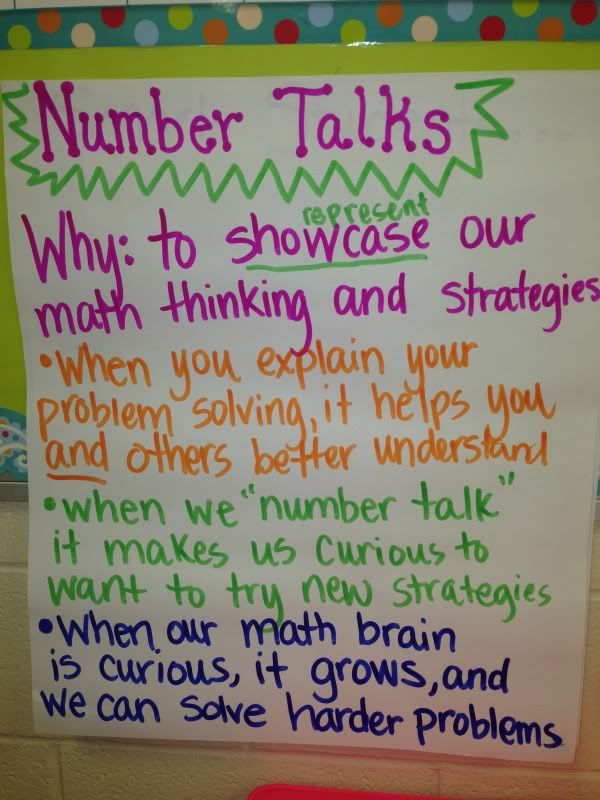
In my classroom, a problem is posed, students silently solve the problem mentally, then they give a "secret thumbs-up" (thumbs-up in front of their body) to let me know they have solved the problem. When the majority of thumbs in the room are up, I begin to cold-call students to share their thinking aloud with the class. As they share, it is your job to ask questions to help clarify and solidify their understanding. Over time, students will begin to ask questions of each other as their curiosity grows. Modeling good questioning and providing students with thinking stems is key in promoting student-to-student interaction. Simple stems like "How did you know to..." or "Why did you choose to..." and "I'm curious about the way you..." can promote a spirit of inquiry, which strengthens understanding for the student explaining, as well as those listening.
Now, this is important, in my classroom, we emphasize the thinking behind the problem solving, as opposed to the correct answer. And because of that, mistakes will be made. But guess what? There is power in mistake making. My favorite mathematician, Jo Boaler explains it:
Now, this is important, in my classroom, we emphasize the thinking behind the problem solving, as opposed to the correct answer. And because of that, mistakes will be made. But guess what? There is power in mistake making. My favorite mathematician, Jo Boaler explains it:
Allowing students to work through the thinking behind their mistakes has proven to be extremely powerful in my classroom. Of course, the environment in which students have a sense of safety to be able to take risks without fear of being labeled a failure is crucial in developing the growth mindset that Jo mentions above.
So, what does it look like?
Number talks look different in every classroom, and as a teacher, you modify it to meet your students learning styles and needs. Youtube has tons of sample number talk lessons that teachers have shared from around the country. Here are a few of my favorites that illustrate how different it can look, yet also show how powerful the mathematical conversations can be.
My students loved the number talk routine this past year, and as their teacher, I loved the impact a small routine had on deepening student understanding, developing mathematical communication skills, and building confidence in our learning. I will definitely continue to number talk with my 3rd graders this upcoming school year. If you still have some fight left in you, I encourage you to check out "Number Talks" by Sherry Parrish.


So what about you? Do you number talk? What has your experience been?
Happy Mathy Monday!


 Posts
Posts


